

A Night to Remember
Coaching a basketball game, winning a rivalry, and witnessing a historic moment.

The air inside the gym was thick with anticipation for an ending that few could have predicted, each player’s ragged breath adding to the tension hanging over the near-capacity crowd.
The atmosphere was electric. In a building that had seen some of the best high school basketball in the state, this game between 8th graders from rival middle schools feels as important as any other in its history.
The score was close, with the sides separated by only a few points and just as many miles across town.
The clock continued to wind down, victory inching closer with each excruciating second that passed. The reality of what was about to happen didn’t feel real, almost dreamlike.
But the job wasn’t finished just yet.
In November of last year, I began teaching 8th-grade English, completing a months-long slog of job hunting.
A few months into the job, I heard students discussing the school’s annual matchup with their cross-town rival that was scheduled for the spring. Curious, I asked around for more details and got in touch with the head coach. The prospect of helping the basketball team seemed like a great way to get involved with the school community.
The coach informed me that he wasn’t able to take charge this year and asked if I was interested in running things. This caught me off guard. I was already coaching a baseball team. Heading up a basketball squad on top of everything else felt like a lot.
Nevertheless, I agreed, accepting that I would be very busy for a month. When I told my parents about it during a visit one weekend, they both just laughed, shook their heads, and said, “Good luck.”
With that injection of familial confidence, I helped assemble a roster of 11 players. It was then that I truly grasped the nature of what I had signed up for.
My school had never once defeated its rival since the series began in 2019. In fact, most years, we weren’t even competitive. Both students and teachers alike described our chances as being virtually nonexistent; their faith in us was overshadowed by what lay in store a few miles away.
Our rivals hailed from a secondary school that enrolled grades 6-12. This addition of three grades nearly doubled their pool of talent, and enabled their basketball coaches to identify and develop players much earlier. The results spoke for themselves, as they’d won numerous state championships as recently as 2023, when they claimed their second consecutive title.
How those at my school talked about them, you’d think their players were all 7-feet tall, could jump over skyscrapers, and could shoot the ball better than Steph Curry. To say that the cards were stacked against us would have been an understatement.
Oh, and because our gym was too small to host the game, we had to travel to their place every year, as if the going weren’t tough enough already.
Who cares, I told myself, perhaps arrogantly. We’ll just outwork them.
For three weeks, we did just that. We focused heavily on breaking our rival’s vaunted press defense that had humiliated us in years past. We incorporated inbounds plays. Each practice included competitions with game-like intensity. And we conditioned ourselves relentlessly.
On the eve of the game, I felt good about how the team had developed and was even starting to become modestly confident in our chances, until one of my centers approached me at school and said that he wasn’t able to play in the game, thanks to a sprained ankle.
I returned to Earth that afternoon, but remained determined to have a productive walk-through. Except for an unfortunate injury, we were as ready as we could be.
I awoke on game day—this past Friday—as nervous as I’d been in years. I put on a coat and tie, believing very much in the philosophy of “look good, feel good, [coach] good.”
When I arrived at school that morning, the game was on everyone’s minds. Students and teachers buzzed about the day’s festivities that included a school-wide pep rally. I began to appreciate how important this was to my school. After all, the district in which I teach doesn’t have middle school sports. In a very real sense, this game was our Super Bowl.
After shoot-around and a team dinner, we made the brief bus ride to our opponents’ gym. Our game was scheduled for 7:15, so we watched the girls’ team play first.
Their contest unfolded exactly as I imagined the boys’ games had gone over the years. Our rivals were on them from the opening tip, not giving them an inch of space to breathe. The hosts’ lead quickly ballooned, and by halftime, they were up nearly 30 points.
As I led my team to the locker room, I gained a new appreciation for what was at stake. For two quarters, I watched as the girls were beaten in every facet of the game to the delight of the opposing fans, whose cheers were deafening from across the court. My school traveled well, filling up about half the gym, but we were very much still the visitors. The game felt fast, too fast, as if we weren’t expecting its pace to be so breakneck.
I immediately pictured what it would feel like to be on the receiving end of such a total drubbing and shuddered. Then I remembered that my family, who were coming in for the weekend, would be in attendance for the game, and the feeling got worse.
But in the locker room, my anxiety faded. My focus sharpened. The intense desire to win took hold once again. My pre-game speech may not have matched Herb Brooks’ famous words to Team USA before facing the Soviet Union in the 1980 Winter Olympics, but its message was essentially the same: seize the opportunity that lay before you and make history. Why not us?
At the conclusion of the girls’ game, we took the court for pre-game warmups. The crowd was larger than it was when we entered the locker room, and the atmosphere had grown equally fever-pitched.
A national anthem, a lineup introduction, and a buzzer later, 10 players stood at half-court for tipoff. My team’s modestly adorned black jerseys stood in stark contrast to our opponents’ crisp orange-and-white uniforms.
The ball went up, and after weeks of build-up, the game was finally, mercifully, underway.
We knew coming into the game that we wouldn’t match up well physically with the other team; the chatter about them was partially true in that they were bigger at nearly every position. To compensate, we decided to come out in a 2-3 zone, hoping to force them to initiate offense rather than allow them to exploit mismatches.
It worked better than I could have hoped. After one 8-minute quarter, we held a 4-2 lead. There were plenty of turnovers, fouls, and missed shots in what was a largely out-of-control opening frame.
Never mind that. We had a lead.
The second quarter was largely the same, except we found a rhythm on offense. We made breaking the press look routine. Our passes were crisper, our cuts to the rim more decisive. On the other end, we continued to suffocate them on every possession, squeezing the life out of their up-tempo attack.
I was certain that we couldn’t sustain this pace. All 11 guys had played at that point, but the creeping feeling of dread that precedes a collapse seemed to grow larger. We kept up, though, despite being badly out-rebounded, and took a 10-5 lead at half-time. It was a rock fight in every sense of the phrase. I hyped up our crowd in an adrenaline-fueled haze as we made our way to the locker room.
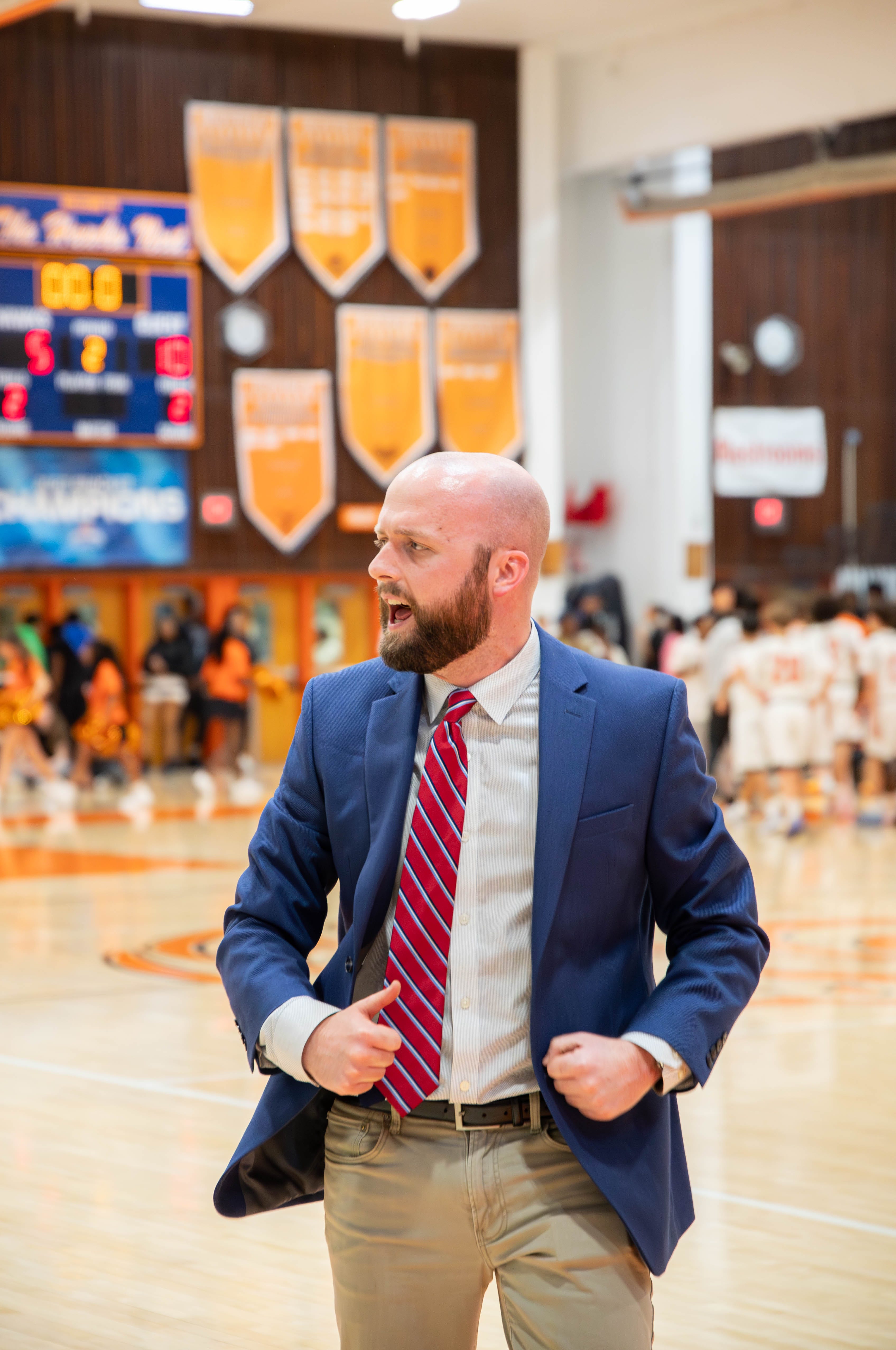
My message was simple: suffocate them on defense and take our time on offense with deliberate action. Most of all, meet the moment. They were going to eventually dust themselves off and punch back, and we had to be ready, both for their game plan and for the home crowd to try to retake the momentum.
Our opponents came out swinging in the second half, using a high-post maneuver to break our zone. The approach worked and cut into our lead. This seemed to rattle my team, who looked a step slow in breaking the press, resulting in sloppy turnovers. Our rebounding disadvantage only compounded our bad situation, on the wrong end of a 15-7 run that put us down by one entering the fourth quarter.
The spirit on our sideline was shaken, but not broken. I implored my players to stay the course, and reminded them that we knew we’d be challenged eventually. Adversity was here. We could either meet it head-on or pack it in. The choice was theirs.
We redoubled our efforts to stymie their offense, and went with a bigger lineup to open the final quarter. This slowed them just enough to allow us to regain our footing, and we took the fight to them.
The two teams traded blows for the next several minutes, until one of our guards lined up a three-pointer from the wing that found the bottom of the net and sent our fans into a frenzy. We had a 26-24 lead with 3:09 remaining.
My voice at this point in the game was mostly gone after hours of straining to be heard over the cries of a crowd on its feet. With what vocal strength I had left, I challenged my players to give me the best three minutes of basketball possible. For most of these guys, this was by far the biggest game of their lives, so my charge was apt, or so I hoped.
With the momentum back on our side and our fans becoming increasingly vocal as the game entered its twilight phase, our foes became more desperate, taking unnecessary risks with the ball in their hands and playing more aggressive defense. They put us on the free throw line, hoping to make us earn the win.
Time and time again, my guys stepped to the line with the weight of not only this game but six years of misery resting on their shoulders, and sank shots to keep our dream alive.
Holding a three-point lead with a little under 10 seconds remaining, we had to get the ball inbounded cleanly. I called a timeout and drew up a play to get the ball into my point guard’s hands. Like clockwork, the action had its intended effect. After he missed the first attempt at the line, I shouted across the court for his attention and motioned for him to take a deep breath. He did as I asked and, with the confidence of someone who’s been there and done it before, he sank the second free throw, casting a sidelong grin my way as he did so.
With a heartbeat left on the clock and a four-point lead in hand, the urge to begin celebrating was profound, and I started to before realizing that our foes had one last attempt waiting. Sprinting toward the scorer’s table, I screamed with burning lungs for my team not to foul.
They inbounded the ball, and before I knew it, the buzzer sounded.
The game was over. We had our own little miracle.
As my players streamed across the court toward our stands to take part in the celebration, I stood watching the scene from the free throw line, taking in the moment and allowing myself to finally breathe for the first time all day.
We had done it. Against all odds, we’d accomplished what no other team in school history had been able to. The feeling I had was euphoric. Seeing players, students, and parents come together on the court to take photos and hold the trophy was satisfying beyond belief. But it also filled me with a sense of pride I hadn’t felt in quite some time.
We took a team picture at half-court and slowly made our way toward the locker room. Everyone we passed congratulated us, the party still in full swing, shaking our hands and clapping us on the back.
In the locker room, the players met me at the door with water bottles, dousing me the second I took off my coat. It was pure elation shared by the 13 souls in that room, as the haunting of more than half a decade of humiliation was fully cast off.
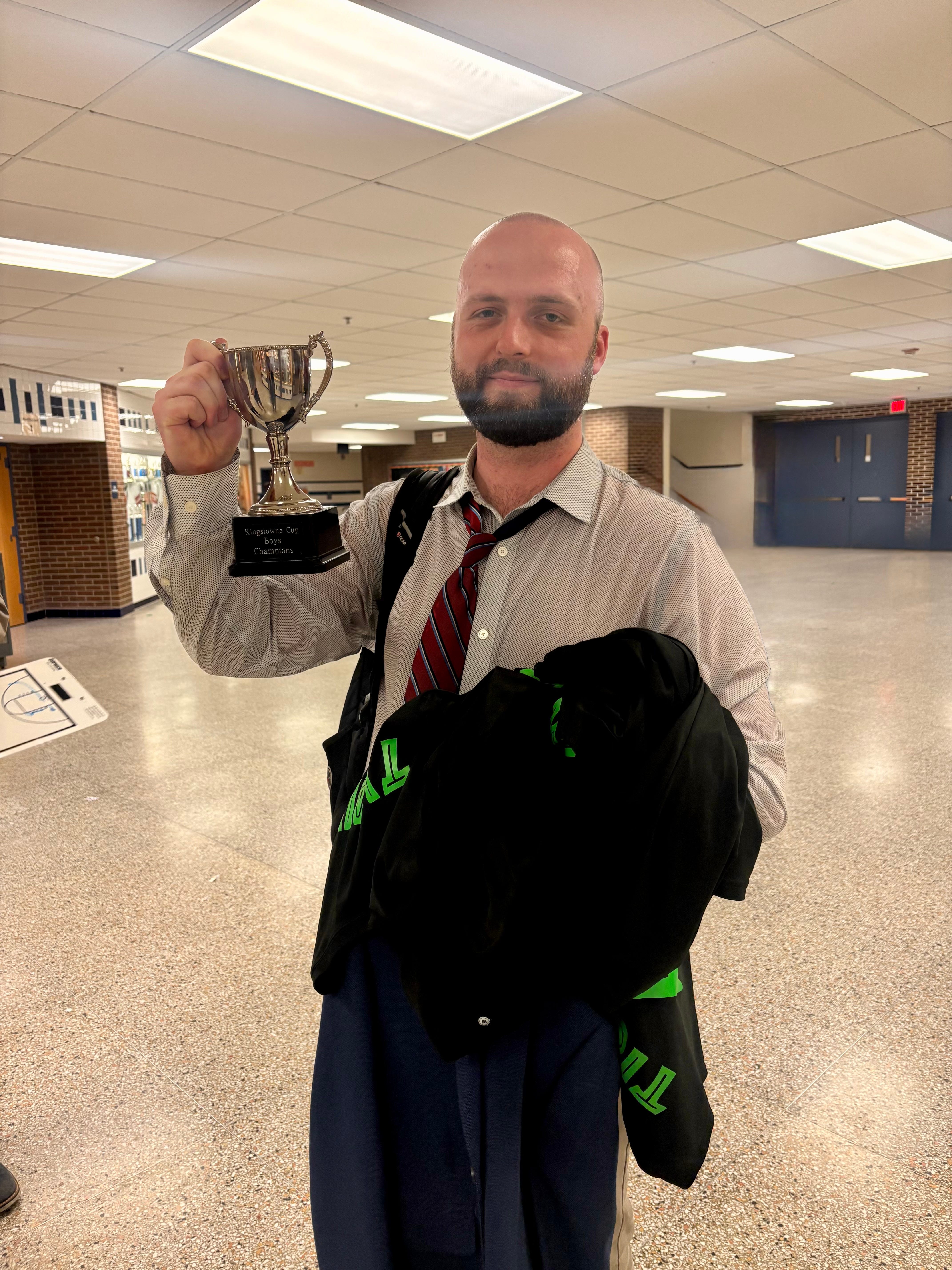
We broke one last team huddle before departing. My family met me in the lobby. I greeted them, drenched, grinning from ear to ear. I learned from my father that the other team’s final half-court shot at the buzzer actually went in. During my rush to celebrate, I didn’t even bother watching the ball go up as the buzzer sounded. As it turns out, it found the bottom of the net, cutting the final score to 32-31. We were that close—one wayward slap on the shooter’s wrist—away from a very different ending to the game, from another year of disappointment to hang over our heads.
This win meant so much to me not only for its scale, but for what the win symbolized to so many. That I was a part of this team was profoundly humbling.
Walking to my car—trophy in hand—I was proud of my players for their resilience and grit. Proud of my school, which has greeted me with open arms. And proud of myself, for having the courage to meet this unexpected challenge with an open mind and the humility to risk failure when the lights were brightest.
It was just our night.
Adam, great read. Congrats on the big win! I see a new career in coaching.